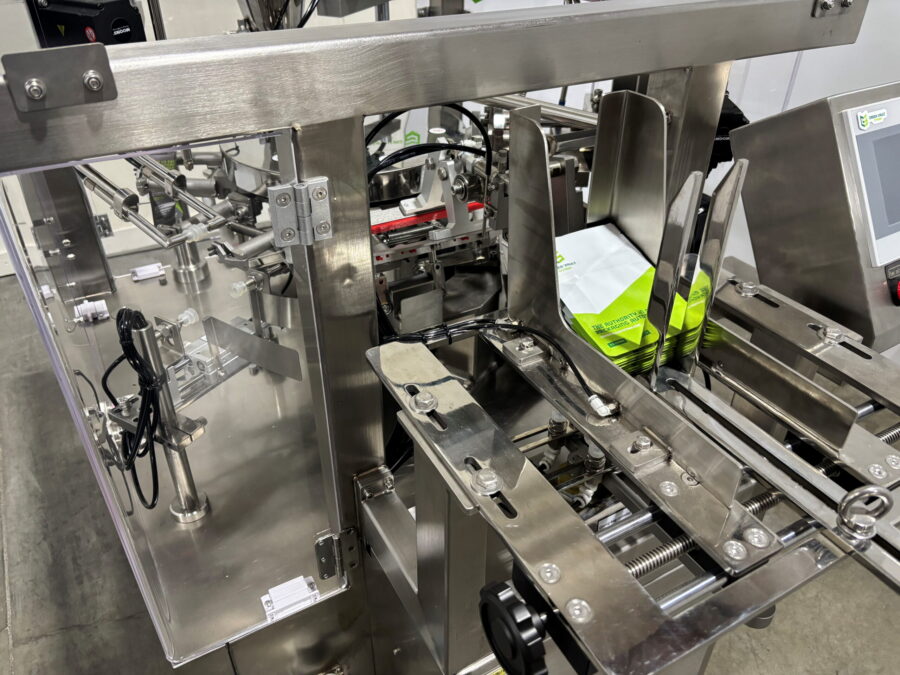
Servo vs. Cam-Driven Bagging Machines: What Cannabis Operators Need to Know About Modern Bagging Automation
When cannabis operators start evaluating bagging automation, most conversations revolve around speed, price, or footprint.
But the most important factor…the one that actually determines efficiency, uptime, and long-term ROI…is often overlooked:
How the machine is driven
Specifically:
Servo-driven vs. cam-driven bagging systems
This distinction is more than technical. It fundamentally changes how your operation runs.
What Is a Cam-Driven Bagging Machine?
Cam-driven systems are the traditional standard in packaging machinery.
They rely on:
- Mechanical linkages
- Rotating cams
- Fixed motion paths
In simple terms:
One central mechanical system controls the entire machine.
Every station: gripping, opening, filling, sealing, moves based on that shared mechanical timing.
What this means in practice:
- Movements are fixed and interconnected
- Adjustments require physical changes to the machine
- Timing is mechanical, not programmable
Cam-driven systems work well in industries like food production where:
- SKUs don’t change often
- Runs are long and consistent
- Changeovers are infrequent
That’s not cannabis.
What Is a Servo-Driven Bagging Machine?
Servo-driven systems replace mechanical control with digitally controlled motors.
Instead of one central system:
- Each station is independently controlled
- Movements are programmable
- Adjustments are software-based
Think of it like this:
- Cam-driven = analog
- Servo-driven = digital
What this means in practice:
- Each motion can be fine-tuned
- Settings can be saved and recalled
- The system adapts to different products instantly
The Real Difference: On the Production Floor
This is where the gap becomes obvious.
1. Changeovers: Minutes vs. Hours
In cannabis, changeovers are constant.
You’re switching:
- Bag sizes
- Fill weights
- SKUs
Cam-driven systems:
- Require manual adjustments
- Operators loosen, reposition, recalibrate
- High risk of misalignment
Servo-driven systems:
- Select a preset on the HMI
- Machine adjusts automatically
Impact: You can recover 1+ hour per day in production time just from changeovers.
2. Operator Dependency: Mechanical Skill vs. Usability
Cam systems require operators who understand:
- Timing relationships
- Mechanical alignment
- System dependencies
If something is off:
- It can cascade across the machine
Servo systems simplify this:
- Operators interact with programs, not mechanics
- Adjustments are controlled through software
Impact: Faster training – Less reliance on specialized labor – Lower risk of operator error
3. Consistency and Output Quality
Mechanical systems rely on:
- Physical synchronization
- Wear-prone components
- Fixed motion paths
Over time:
- Small inconsistencies compound
- Performance drifts
Servo systems:
- Control each station independently
- Maintain precision through digital feedback
- Allow fine-tuning at every stage
Impact: More consistent bag quality – Reduced rework – Higher overall yield
4. Downtime and Maintenance
Cam-driven machines:
- Require physical adjustments
- Experience wear across linked components
- Take longer to troubleshoot
Servo-driven machines:
- Fewer mechanical dependencies
- Easier diagnostics
- Faster recovery from issues
Impact: Less downtime = more production hours per week
Why This Matters Specifically in Cannabis
Most packaging equipment wasn’t designed for cannabis.
It was adapted from industries where:
- Products are uniform
- Runs are predictable
- Changeovers are rare
Cannabis is the opposite:
- High SKU variability
- Frequent format changes
- Constant operational adjustments
This is why many operators feel friction with traditional equipment. It’s not built for how they actually run.
Servo-driven bagging aligns with:
- Real-world workflows
- Multi-SKU production
- Rapid operational shifts
The Unseen Cost of Cam-Driven Systems
On paper, cam-driven machines may appear:
- Less expensive
- Simpler
But the real cost shows up in operations:
- Lost time during changeovers
- Increased labor requirements
- Higher risk of errors
- Slower throughput
Example (Modeled):
If your team spends:
- 1 hour/day on changeovers
That’s:
- 250+ hours/year lost
At even modest production value, that quickly exceeds the upfront savings of a cheaper machine.
Check Your Numbers
How Much Labor Waste Is Hiding in Your Bagging Process?
Estimate your lost time and labor in under 30 seconds.
Based on typical cannabis production workflows. Adjust values to match your facility.
Where Servo Systems Fit in the Market
Historically, servo-driven systems have been:
- More expensive
- Found in large-scale industrial applications
That’s changing.
New systems are now hitting a critical middle ground:
High-performance servo control without enterprise-level cost
This creates a new category:
- More advanced than entry-level baggers
- More flexible than traditional rotary systems
- More accessible than large industrial machines
For cannabis operators, this is the first time servo technology truly fits the market. Meet the Compact Rotaty Bagger!
Where the Precision Bagger Fits
Understanding servo vs. cam is one thing, having a machine that actually delivers those advantages is another.
The Compact Rotary Bagger is built to bring servo-driven performance into real cannabis operations without the complexity or cost of large industrial systems.
- 100% servo-driven control for precise, repeatable performance
- Fast digital changeovers via HMI means minutes, not hours
- Rotary design with up to 30 units/min for consistent throughput
- Simple, program-based operation that reduces operator dependency
Built for Cannabis, Not Adapted to It
Unlike traditional systems, the Precision Bagger is designed for:
- Frequent SKU changes
- Multiple bag sizes per shift
- Constant operational adjustments
It also integrates directly into the GVS ecosystem, allowing operators to:
Switch from jarring to bagging in minutes using the GVS P-Flex.
The Result
A system that combines speed, flexibility, and control. Built specifically for how cannabis production actually runs.
How This Connects to Overall Packaging Strategy
Choosing between servo and cam isn’t just about machinery. It’s about how your operation scales.
When paired with:
- Lower-cost packaging formats (like bags)
- Integrated upstream automation
- Flexible production systems
Servo-driven bagging becomes a multiplier:
- Faster output
- Lower cost per unit
- Greater operational control
The Bottom Line
The difference between servo and cam-driven systems comes down to one thing:
Control
- Control over changeovers
- Control over consistency
- Control over labor
- Control over production time
In an industry where margins are tightening and competition is increasing, that control is a competitive advantage and could be the differentiator between thriving and going out of business.
Contact Us to Get Started
Want to see how cannabis bagging automation fits into your operation?
- Get a custom ROI breakdown
- Compare bagging vs jarring for your product mix
- Explore full system integration
Click the Contact Us link below to get started.